The Roundhouse
at the Heart
of Yaletown
From locomotive shed to living community — one building’s journey through 135 years of Vancouver history.
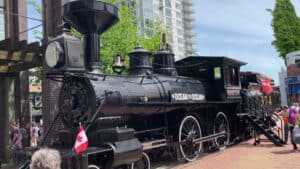
On May 23, 1887, a steam whistle split the coastal air of False Creek. Engine 374 — a gleaming 4-4-0 Canadian Pacific locomotive, rolled into Vancouver carrying 150 passengers on the first transcontinental passenger train to reach the city. That single moment changed everything. Within months, the CPR broke ground on the building that would anchor the neighbourhood forever: the Roundhouse.
More than a century later, that same building stands at the centre of one of Canada’s most celebrated urban reinventions. The Roundhouse is not merely a heritage landmark; it is the living proof that a city can honour its industrial past while building a vibrant, human-scaled future.
“The railroad was the catalyst to growth: in just three years, Vancouver’s population increased over ten times.”
— Vancouver Heritage FoundationTo understand Yaletown today with its cobblestone lanes, converted warehouses, and waterfront parks, you have to begin at the Roundhouse. Everything grew outward from these tracks.
Chapter One
A Town Named After Yale
The name “Yaletown” tells you everything about its origin. In 1886, the City of Vancouver offered the Canadian Pacific Railway a 20-year tax exemption in exchange for establishing its western rail yards on the north shore of False Creek. The CPR accepted. Workers and machinery were moved from Yale, BC, a frontier town in the Fraser Canyon, to this muddy shoreline. And so the neighbourhood took Yale’s name.
What followed was an explosion of industry. Within a decade, Yaletown was home to factories, cooperages, lumber yards, rail yards, and thirteen “beehive burners” — conical kilns that consumed waste wood from the forests of British Columbia. Logs were gathered here, milled into lumber, and shipped out for railway construction and Canadian furniture making. By 1910, Vancouver had become the wholesale capital of western Canada, and Yaletown was at its commercial epicentre.
yards on False Creek
in just three years
Vancouver Heritage Register
At the centre of this industrial world stood the Roundhouse — completed in 1888 alongside its turntable and Machine Shop. These are among the oldest surviving industrial structures in the entire city of Vancouver.
Engine 374 — Canada’s Most Historic Locomotive
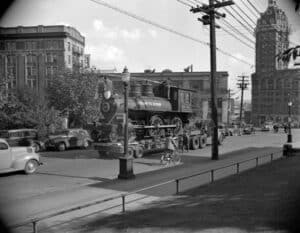
Built in the CPR’s Montreal shops in 1886, Engine 374 hauled the first passenger train into Vancouver on May 23, 1887, carrying 150 passengers over the new 12-mile extension from Port Moody. It remained in revenue service until 1945 — nearly 60 years — before being donated to the City of Vancouver. Decades of neglect followed. Then, restored to glory for Expo 86, it found its permanent home at the Roundhouse.
Chapter Two
A Century of Transformation
Chapter Three
Why the Roundhouse Matters
Heritage buildings are often preserved as curiosities which are roped off, kept at arm’s length, visited but not really lived in. The Roundhouse took a different path. When Concord Pacific agreed to convert it into a community centre as part of the False Creek North Development Plan, they did something rare: they embedded the history directly into everyday life.
Today the Roundhouse serves thousands of Yaletown residents as a genuine gathering place. Potters throw clay in studios overlooking the turntable. Children play on wooden train sets a few metres from Engine 374. Community groups hold meetings in rooms framed by 135-year-old cedar columns. The building is simultaneously a museum, a gym, an arts centre, and a neighbourhood living room.
The Roundhouse, its turntable, and Machine Shop are among the oldest surviving industrial structures in Vancouver. The complex is a designated provincial heritage site and anchors 27 properties listed on the Vancouver Heritage Register in the surrounding district.
That layering is the point. The Roundhouse does not merely commemorate Yaletown’s past; it demonstrates that industrial history and community vitality can share the same roof. The brick warehouses along Hamilton and Mainland Streets tell the same story: preserved facades now sheltering restaurants, design studios, and boutiques that could not exist anywhere else with such raw, authentic character.
“The city recognized Yaletown’s architectural importance by zoning it as a historical district; allowing new uses while maintaining the special character of the area.”
— Yaletown Business Improvement AssociationThe Turntable: Where All Lines Meet
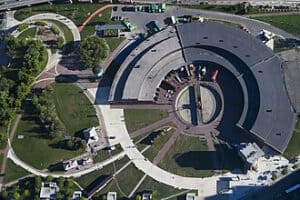
The Roundhouse takes its name from its most essential feature: the central turntable that allowed locomotives to be rotated and directed to any of the maintenance bays radiating outward like spokes from a wheel. In active use, it was pure industrial choreography. Today, restored and still functional, the turntable is both the architectural centrepiece of the community centre and a metaphor for the neighbourhood itself — a point where histories, people, and possibilities converge.
Chapter Four
The Neighbourhood the Roundhouse Built
It is not an exaggeration to say that the Yaletown of today would not exist without the Roundhouse. The decision to save, restore, and repurpose that building that was first for Expo 86, then permanently as a community centre and sent a signal that shaped everything around it.
When developers looked at the Expo 86 lands after the fair closed, they saw potential that could only be unlocked by honouring the existing character. Concord Pacific’s False Creek North redevelopment became one of the most celebrated urban transformations in Canadian history; a dense, walkable, mixed-use community where heritage fabric and modern towers coexist. The preserved brick warehouses along the lanes of Hamilton and Mainland Streets became the commercial spine of a completely new neighbourhood.
What Yaletown offers today are boutique restaurants in century-old loading docks, design studios behind cast-iron awnings, weekend markets along cobbled lanes. These are the direct product of that heritage preservation instinct. Remove the Roundhouse, and there is no anchor. Without an anchor, there is no coherent identity. Without a coherent identity, Yaletown becomes just another tower district.
The Roundhouse Community Arts & Recreation Centre hosts pottery, woodworking, dance, fitness, visual arts, and community programming. Engine 374 is on display daily in its dedicated pavilion at the corner of Davie Street and Pacific Boulevard. Admission is free. The West Coast Railway Association volunteers open the pavilion year-round, offering tours of both the locomotive and its remarkable history.
Each May, on the Victoria Day long weekend, the community marks the anniversary of Engine 374’s original 1887 arrival by rolling the locomotive outside the pavilion, ringing its bell, and gathering in the courtyard where once the turntable spun locomotives through the smoke of a frontier city. It is one of Vancouver’s most quietly moving traditions: a neighbourhood pausing to remember the iron rails that made it possible.
The Roundhouse endures not merely as a monument to the past but as proof of what thoughtful preservation can achieve. It is the reason Yaletown has a soul. And on a clear spring morning, standing in Roundhouse Mews with the copper-riveted flanks of Engine 374 visible through the pavilion glass, and the towers of False Creek rising beyond the turntable, you understand that sometimes the best way to build a future is to keep faith with your foundations.